This website preserves past content and is maintained with occasional updates.
Request tailored, remote support on child protection coordination, information management, and thematic areas.
Demander un soutien à distance sur mesure pour la coordination de la protection de l'enfance, la gestion de l'information et les domaines thématiques.
Solicite asistencia remota sobre coordinación en Protección de la Niñez, gestión de la información y otras áreas temáticas.
.قم بطلب دعم مخصص عن بعد في أي من مجالات تنسيق حماية الطفل وإدارة المعلومات أو أي من مواضيع حماية الطفل الأخرى
South Sudan
--In 2025, South Sudan will continue to experience a protracted child protection crisis, particularly in conflict-affected and underserved areas across the country. Key child protection issues include family separation, recruitment into armed groups, physical and sexual violence, exploitation, and psychosocial distress, particularly among adolescent girls. Children, especially in urban areas. experience high levels of exploitation and resort to enrollment in gangs as an extreme coping mechanism. Children with disabilities and child survivors of GBV, particularly girls, are disproportionately at risk with limited access to essential services such as health, psychosocial support and legal aid.
Response strategy: The Child Protection AoR will focus on delivering child-centred interventions such as comprehensive case management, material support, mental health and psychosocial services and cash-based initiatives. It will emphasize collaboration across sectors and engage communities, the Government and partners to optimize resources. The AoR will also prioritize strengthening child protection systems at the community level, especially in hard-to-reach areas. Ensuring the safety, dignity and well-being of the most vulnerable children is essential to safeguarding their rights in South Sudan’s challenging humanitarian context. The cluster will also provide child protection in emergencies training for community leaders and partners, leveraging local structures for swift mobilization. This approach ensures effective, scalable interventions for South Sudan’s most vulnerable children.
Targeting and prioritization: Targeting is based on vulnerability criteria, focusing on those exposed to family separation, recruitment by armed groups, violence (including GBV), exploitation and psychosocial distress. The AoR will prioritize the voices of affected people – particularly children, adolescents, youth and young women.
Key Figures
2025 Response plan in numbers
Country Overview
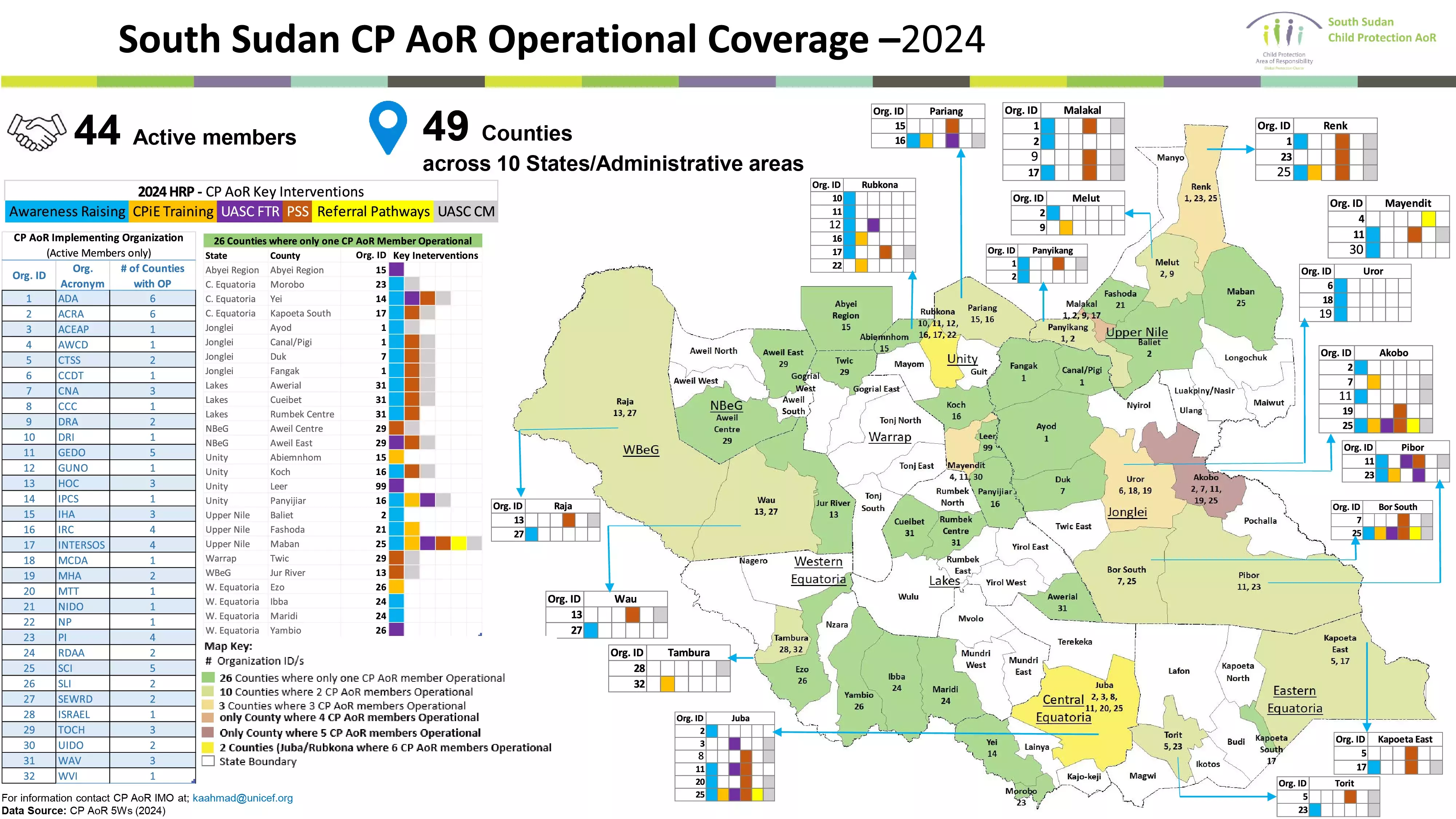
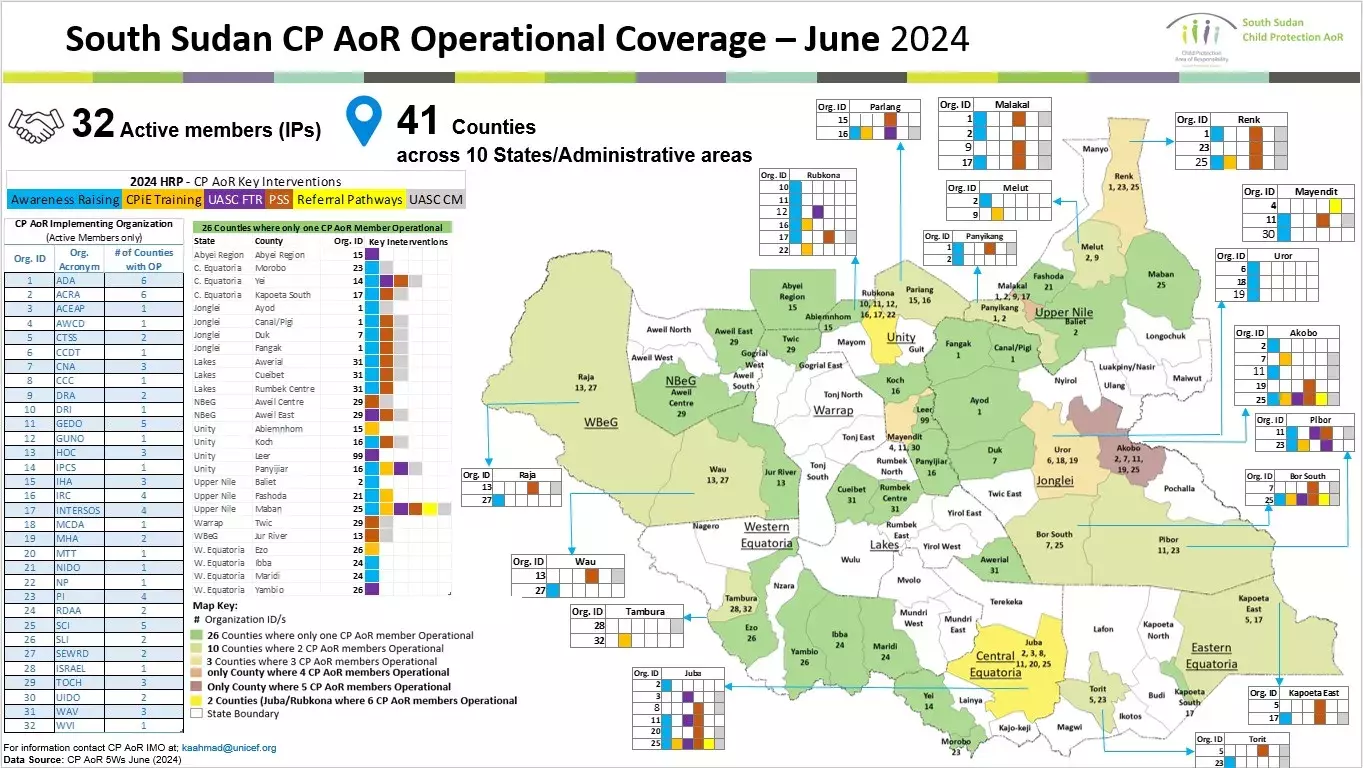
An estimated 2.7 million people, including 2.3 million children, are at risk of violence, exploitation, abuse, and neglect and in acute need of immediate child protection in 2021. Children continue to be disproportionately affected by crisis and exposed to multiple protection risks including recruitment by armed groups, psychosocial distress, family separation, violence and exploitation in 61 most affected counties.
High level of stress, loss of friends and family members are also taking a toll on mental health and emotional development of children, further exacerbated by the COVID-19 outbreak. Studies suggest that at least one in three respondents met the criteria for a mental disorder. A recent FSNMS assessment found that 30 per cent of children had behavioral change, showing signs of distress due to repeated exposure to conflict and shocks.
Since the outbreak of violence in December 2013, 26,184 (12,214 girls and 13,970 boys) cases of unaccompanied and separated children (UASCs), missing and other vulnerable children have been documented in South Sudan and only 6,348 reunified, with up to 4,000 children yet to be reunified.
Immediate life-saving child protection services will be provided to 800,000 out of 2.7 million vulnerable children. MHPSS, community-based child protection (CBCP), and family tracing, reunification and alternative care for unaccompanied and separated children's approaches will be expanded. CVA; extension of services to children in contact with the law; support to child survivors of sexual violence; community-based reintegration services for children separated from armed forces or armed groups; and technical and institutional capacity strengthening of local actors, frontline child protection workers and community volunteers will be strengthened.
The most vulnerable children including children who are displaced in conflict hotspots, associated with armed forces and groups, in detention, unaccompanied and separated, returnees and those living in host communities will be assisted based on need and vulnerability, particularly in conflict-affected areas.
Preventive and responsive child protection programming will be promoted through the use of MHPSS mobile teams; awareness raising, expansion of case management for child survivors of GBV; integration with other sectors; door to door visits; situation and response monitoring; and the use of different communication platforms to promote resilience and reduce negative coping strategies. The Child Protection Sub-Cluster will roll out the community care strategy to prevent and mitigate sexual violence against girls and support local community leaders taking leadership roles in child protection. The sub-cluster will strengthen child protection systems, such as Child Protection Information Management System (CPIMS+) roll out, social workforce strengthening, cash-based assistance and peacebuilding.
Highlights
Key resources